Your Business Has Been Running for 20 Years. So Why Is It Still Stuck at Sub ₹100 Crores?
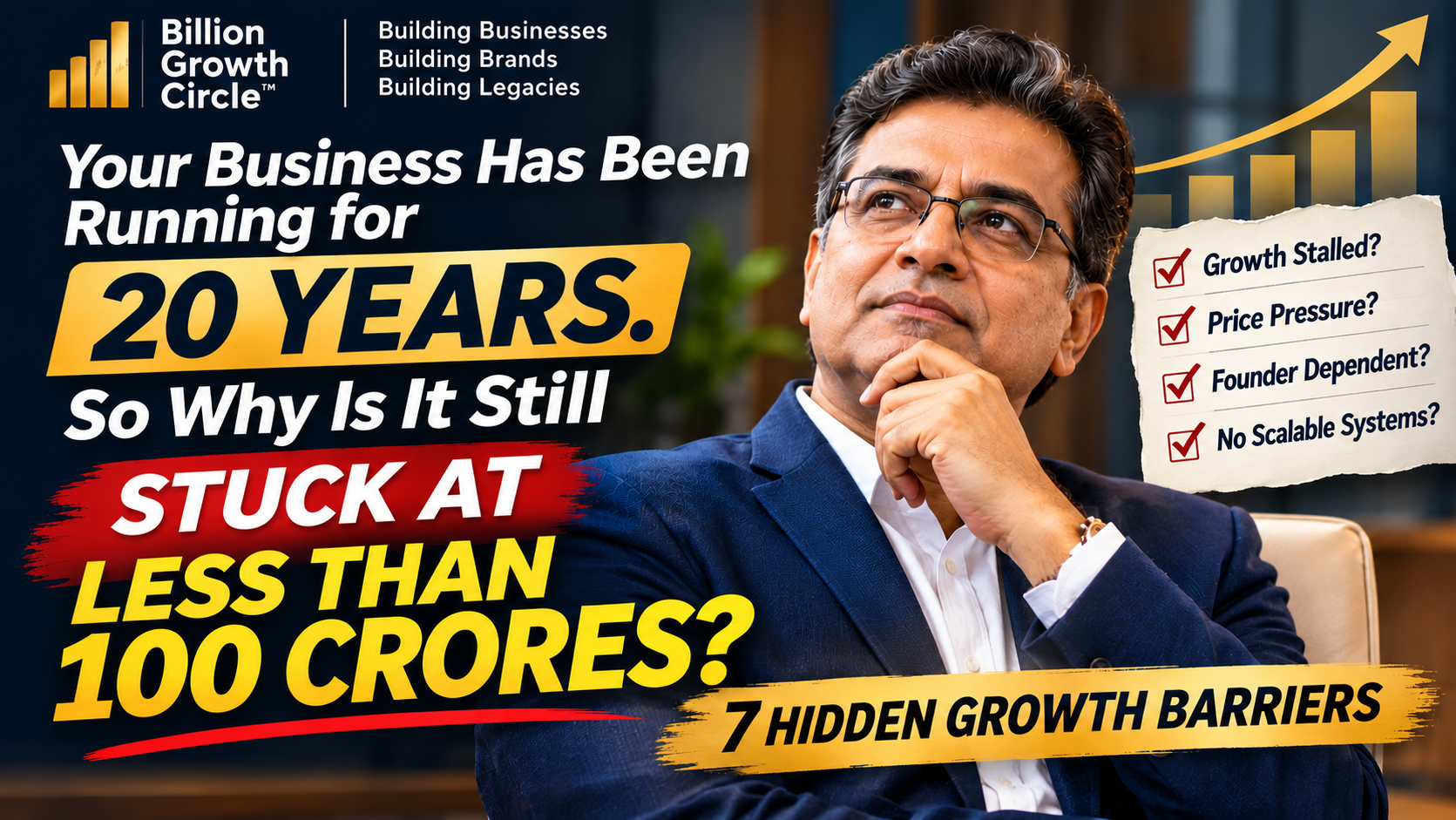
Imagine this.
You started your business 20 years ago.
You have survived difficult markets, economic slowdowns, changing customer preferences, aggressive competitors and countless challenges.
You have built a team. Developed relationships. Acquired customers. Established a reputation.
Your business generates respectable revenue. Your family is reasonably comfortable. People in your industry know you.
Yet something doesn't feel right.
Your business is not growing at the pace you expected.
You are still involved in almost every important decision. Your team keeps coming back to you for approvals. Customers negotiate relentlessly. Competitors are catching up. New opportunities emerge, but you struggle to pursue them because the existing business consumes all your time.
You have tried hiring more people, increasing marketing expenditure, launching new products and expanding your operations.
But the needle barely moves.
And somewhere in the back of your mind, there is an uncomfortable question:
After building this business for 20 years, why am I still working so hard to keep it growing?
If this sounds familiar, you may be experiencing what I call the Growth Ceiling Trap.
The problem may not be your product, your market or even your competition.
The problem could be that the business model, leadership approach, systems and brand positioning that helped you reach your current level are no longer capable of taking you to the next one.
Let's understand why.
The uncomfortable truth: What got you here may not get you there.
When you started your business, speed, personal relationships, hard work and hands-on involvement were probably your greatest advantages.
You knew your customers personally. You negotiated with suppliers. You supervised employees. You solved problems yourself.
Your ability to personally manage almost everything helped you build the business.
But as the business grew, the same approach may have quietly become its biggest limitation.
Consider the difference:
| The business you built | The business you need to build |
|---|---|
| Founder-driven | Leadership-driven |
| Personal relationships | Institutional relationships |
| Informal processes | Documented systems |
| Product-led selling | Brand-led positioning |
| Revenue-focused | Profitability and value-focused |
| Reactive decisions | Strategic planning |
| Owner-dependent operations | Professionally managed operations |
The transition from one column to the other is not automatic.
It requires a fundamental transformation in how you think about, structure and lead your business.
Here are seven barriers that may be holding you back.
1. You are still the biggest bottleneck in your business.
Let's start with an uncomfortable question.
Can your business function effectively for 30 days without your personal involvement?
If the answer is no, you may not have built an independent enterprise. You may have built a business that depends on your personal availability.
Think about your typical day.
- Your sales team needs your approval before offering a discount.
- Your purchase manager checks with you before placing a large order.
- Your accounts team waits for your instructions.
- Your employees escalate routine customer complaints.
- Your senior managers hesitate to take responsibility for important decisions.
You are simultaneously the CEO, sales head, purchase manager, problem solver and final authority.
You may feel indispensable.
But being indispensable is not necessarily a sign of business strength.
It may indicate that your organisation has not developed the leadership capacity to function independently.
The growth breakthrough: Transition from Chief Problem Solver to Chief Growth Architect.
Start by identifying the 10 decisions that consume most of your time.
Classify them into three categories:
- Decisions that only you should make.
- Decisions that can be made by your leadership team within defined limits.
- Decisions that should be completely delegated through documented processes.
Build accountability around outcomes rather than approvals.
Your goal should be to make the organisation increasingly capable of taking decisions without waiting for you.
2. You are chasing revenue instead of building a growth architecture.
Many business owners approach growth with a familiar formula:
More customers. More salespeople. More products. More marketing. More branches.
But growth is not simply about increasing activity.
It is about creating a business architecture in which multiple growth drivers work together.
For example, a business generating Sub ₹100 Crores may have:
- A large customer base but poor repeat purchases.
- Strong sales but weak margins.
- Good products but inadequate market differentiation.
- High customer acquisition costs.
- Excessive dependence on a few large customers.
Increasing sales without addressing these structural issues can make the business more complicated without making it significantly stronger.
The growth breakthrough: Build a balanced growth architecture.
Evaluate five drivers:
- Market opportunity — Are you playing in a market with sufficient growth potential?
- Customer acquisition — Can you attract the right customers consistently?
- Customer value — Can you increase repeat purchases, average order value and lifetime value?
- Profitability — Are your products, customers and channels generating healthy contributions?
- Scalability — Can you grow without increasing complexity and costs at the same rate?
Don't just ask, "How do I increase my sales?"
Ask, "What must change in my business model to make growth more predictable and profitable?"
3. Your customers see you as a supplier, not a premium brand.
This is one of the most underestimated barriers to growth.
You may have an excellent product. Your quality may be better than competitors. Your service may be exceptional.
Yet customers continue to compare your prices with everyone else.
Why?
Because being good at what you do does not automatically make your business a preferred brand.
If customers cannot clearly understand why you are different, why they should trust you and why your offering deserves a premium, they will often use price as their primary decision-making factor.
This creates a dangerous cycle:
You offer discounts to win customers. Your margins reduce. You spend more to acquire business. Competitors respond with lower prices. You work harder to maintain revenue.
And your business remains trapped in a commodity mindset.
The growth breakthrough: Move from selling products to building brand preference.
Start with five questions:
- Who is your ideal customer?
- What specific problem do you solve better than competitors?
- What makes your business genuinely different?
- What should customers remember about your brand?
- Why should customers pay more to buy from you?
Your brand should represent a compelling promise, a distinctive position and a consistent customer experience.
A strong brand does not simply make your business look attractive.
It gives customers a reason to choose you, trust you and remain loyal to you.
4. Your business runs on people's memory instead of systems.
Walk into many growing family businesses and you will discover something interesting.
Important business knowledge exists in people's heads.
The sales manager knows which customers need special treatment. The purchase manager knows which supplier offers the best deal. The owner knows which employee can handle a difficult situation.
But very little of this knowledge is documented, standardised or transferable.
What happens when an employee leaves?
What happens when the business doubles its customer base?
What happens when a new branch opens?
What happens when the founder is unavailable?
The organisation struggles because it is operating through individual memory rather than institutional systems.
The growth breakthrough: Build a business operating system.
Begin with seven essential systems:
- Lead generation and customer acquisition.
- Sales pipeline and conversion management.
- Customer relationship management.
- Procurement and inventory management.
- Financial planning and cash-flow management.
- Human resource management and performance accountability.
- Management reporting and business reviews.
Document the critical processes.
Define ownership.
Establish measurable outcomes.
Use technology and automation where they genuinely improve execution.
Remember: Systems are not about bureaucracy. They are about making business performance repeatable.
5. Your team is working for you, but not thinking like business owners.
You may have talented employees. You may even have experienced managers.
But do they understand the business well enough to make decisions independently?
There is a significant difference between having employees who complete assigned tasks and having leaders who take responsibility for business outcomes.
A sales manager who merely reports sales numbers is different from one who owns revenue, margins, customer acquisition and team performance.
A production manager who simply supervises output is different from one who owns quality, productivity, wastage and delivery commitments.
The growth breakthrough: Build a leadership organisation, not just an employee hierarchy.
Start by:
- Defining clear responsibilities for every leadership role.
- Creating measurable KPIs linked to business objectives.
- Conducting structured weekly reviews.
- Empowering managers with decision-making authority.
- Developing future leaders through coaching and mentoring.
- Linking rewards to measurable business outcomes.
Your role must gradually shift from supervising activity to developing leaders.
The ultimate test of leadership is not how many decisions you make.
It is how many capable decisions your organisation can make without you.
6. Your family business has no clearly defined next-generation growth agenda.
Family businesses have a unique advantage: they combine business experience, relationships, values and a long-term perspective.
But they also face a challenge that ordinary businesses may not encounter in the same way.
The founder's vision and the next generation's aspirations may be very different.
The founder may believe that the existing business model has worked successfully for decades.
The next generation may want digital transformation, professional management, new markets, innovation and a different brand identity.
Without a common direction, this difference can turn into conflict.
The founder feels that the younger generation does not appreciate the sacrifices made.
The next generation feels that the organisation is resisting change.
Meanwhile, the business loses valuable time.
The growth breakthrough: Build a shared family business vision.
Have structured conversations around:
- Where should the business be in the next five and ten years?
- Which markets and categories should it enter?
- What should the next generation own and lead?
- Which aspects of the existing business should be preserved?
- What needs to be modernised?
- What governance and decision-making structures are required?
The objective is not to replace the founder's experience with the next generation's enthusiasm.
It is to combine the wisdom of experience with the courage to innovate.
Your business should become a platform where generations collaborate to build something greater than either could build alone.
7. You are managing today's business instead of preparing for tomorrow's opportunities.
Markets are changing.
Customer expectations are evolving. Technology is transforming industries. AI is changing how businesses market, sell, analyse and operate.
Your competitors may be adopting new technologies, entering new customer segments and building stronger brands.
Meanwhile, you may be spending most of your time managing today's problems.
This creates a dangerous strategic gap.
The business may be profitable today but increasingly vulnerable tomorrow.
The growth breakthrough: Build a future-ready enterprise.
Start by evaluating:
- Your industry's emerging opportunities and threats.
- Your readiness to adopt AI and automation.
- Your digital customer acquisition capabilities.
- Your ability to launch new products and business models.
- Your competitiveness in national and international markets.
- Your ability to attract and retain next-generation talent.
You don't have to adopt every new technology or chase every emerging trend.
But you must develop the ability to recognise change early and respond strategically.
The future belongs to businesses that continuously reinvent themselves without losing sight of their core strengths.
The BGC Growth Ceiling Diagnostic: Seven questions every business owner must answer.
Let's bring these seven barriers together.
Rate your business honestly on each parameter.
| Growth dimension | Diagnostic question |
|---|---|
| Leadership | Can the business operate effectively without your daily involvement? |
| Strategy | Do you have a clear, measurable three-year growth roadmap? |
| Branding | Do customers choose you for your differentiation rather than simply your price? |
| Systems | Are critical processes documented and consistently followed? |
| People | Can your leadership team independently own business outcomes? |
| Family alignment | Do the founder and next generation share a common business vision? |
| Future readiness | Is your business actively preparing for AI, automation and market disruption? |
Give yourself a score from 1 to 10 for each dimension.
A low score is not a reason to panic. It is an indication of where you should focus your attention.
The purpose of this diagnostic is to identify the gaps between the business you currently operate and the enterprise you aspire to build.
Your next 90 days: Stop chasing growth. Start architecting it.
Here is a practical roadmap to begin breaking your growth ceiling.
Days 1–30: Diagnose
- Evaluate the seven growth dimensions.
- Identify your three biggest business bottlenecks.
- Review profitability, customer segments and market positioning.
- Identify decisions that depend excessively on the founder.
- Align your leadership team around the most important priorities.
Days 31–60: Design
- Define your next growth milestone.
- Refine your brand positioning and differentiation.
- Identify the systems that need to be established.
- Define leadership responsibilities and performance measures.
- Develop a practical business transformation roadmap.
Days 61–90: Deploy
- Implement the first critical business systems.
- Introduce structured leadership reviews.
- Strengthen your customer acquisition and brand-building initiatives.
- Begin appropriate AI and automation adoption.
- Measure progress against clearly defined business outcomes.
Don't attempt to change everything simultaneously.
Choose the three most important constraints and address them systematically.
A final thought: You didn't build your business just to remain busy running it.
You started your entrepreneurial journey with a dream.
Perhaps it was financial independence. Perhaps it was building something meaningful for your family. Perhaps it was creating a respected name in your industry.
But somewhere along the journey, running the business may have become more important than building its future.
It is time to change that.
Your next growth milestone may not require more working hours, more employees or more marketing expenditure.
It may require a different way of thinking, a stronger brand, better leadership, professional systems and a more ambitious vision.
Don't just build a bigger business. Build a better business. Build a brand. Build an institution. Build a legacy.
That is the transformation we believe Indian family businesses are capable of achieving.
Discover what's really holding your business back.
At Billion Growth Circle, we help family business owners and founders identify their growth blind spots, strengthen their brand positioning, build scalable systems and prepare their businesses for the next phase of growth.
Start with one important question:
What is the biggest thing preventing your business from reaching its next milestone?
Take the BGC Business Blind Spots Assessment and discover the areas that deserve your attention.
DISCOVER YOUR BUSINESS BLIND SPOTS
Billion Growth Circle — Building Businesses. Building Brands. Building Legacies.
Frequently Asked Questions
1. Why do family businesses stop growing after reaching a certain revenue level?
Growth can plateau when the business outgrows its original operating model. Founder dependency, weak systems, limited differentiation, leadership gaps and poor strategic planning can all restrict further growth.
2. How can I scale my business from Sub ₹100 Crores to ₹100 Crores?
There is no universal formula. The business must evaluate its market opportunity, customer acquisition, brand positioning, profitability, leadership capacity, operating systems and ability to scale without increasing complexity disproportionately.
3. How important is branding for family business growth?
Branding helps a business establish differentiation, build trust, improve customer preference and reduce excessive dependence on price competition. It should be connected to the actual product and customer experience.
4. How can I make my business less dependent on me?
Document critical processes, delegate decisions with clear authority, establish leadership accountability, implement management systems and develop people who can independently own business outcomes.
5. When should a family business begin succession planning?
Succession planning should begin well before a leadership transition becomes urgent. It involves preparing future leaders, aligning family expectations, defining governance and ensuring continuity of business knowledge.
6. Can AI help traditional family businesses grow?
Yes. Depending on the business, AI can support customer service, marketing, sales analysis, forecasting, reporting and operational productivity. Adoption should begin with clearly identified business problems and appropriate data and security controls.
Then you are the person this room was built for. Let's keep the conversation going.
What did this stir in you?
Leave a comment. Your voice belongs here as much as anyone else's.
Loading comments…