Are You the CEO of Your Business or Its Most Expensive Employee?
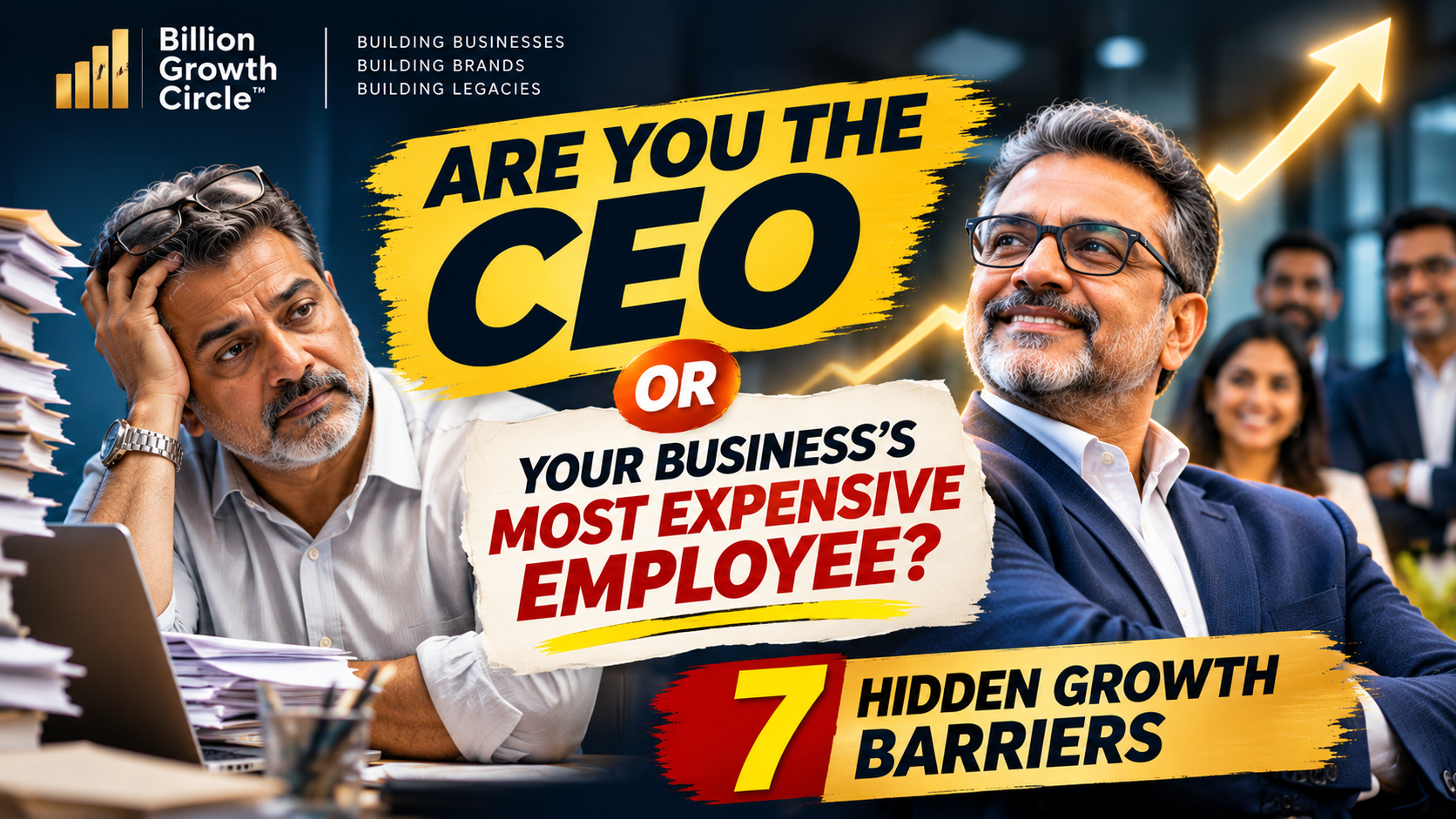
A business should grow beyond the person who started it. But in many Indian family businesses, the founder remains the chief salesperson, chief problem-solver, chief approver and the final authority on almost everything.
You arrive before everyone else. You leave after everyone else. Your phone rings through the day. Your team comes to you for decisions. Customers want to speak to you. Suppliers wait for your approval. Even routine matters somehow find their way to your desk.
You are working harder than anyone in the organisation.
But here is an uncomfortable question:
Are you actually building a business—or have you built a job that you cannot take a holiday from?
This is one of the most overlooked barriers to business growth in India. A founder may have spent 15, 20 or even 30 years building a successful enterprise, yet the business still struggles to function independently.
The founder is not merely leading the business. The founder is the business.
And that creates a ceiling.
The founder paradox: Your greatest strength can become your biggest limitation
In the early days of a business, founder involvement is essential.
You know the customers. You understand the product. You negotiate with suppliers. You manage cash flow. You solve problems quickly because you know every detail.
This hands-on approach helps a business survive and establish itself.
But what helps a business start is not necessarily what helps it scale.
As the organisation grows, the same habits can become counterproductive.
The founder continues to: - Approve purchases and payments. - Handle important customer conversations. - Resolve operational issues. - Review every quotation and proposal. - Make hiring and people decisions. - Intervene whenever targets are missed. - Take the final call on even routine matters.
The team learns to wait. Managers hesitate to take ownership. Decisions slow down. The founder becomes overwhelmed.
The business has grown in size, but its operating model has not evolved.
7 signs that you have become your business's most expensive employee
1. Nothing important moves without your approval
A quotation cannot go out. A purchase cannot be finalised. A customer complaint cannot be resolved. A team member cannot make a decision.
Everything waits for you.
Ask yourself: Are these genuinely strategic decisions, or have you simply trained the organisation to seek your permission?
A CEO should focus on decisions that shape the future—not become the approval desk for the present.
2. Your team brings problems, not solutions
Your managers regularly approach you with questions:
"What should we do?"
"Can you speak to the customer?"
"Should we approve this?"
"How do we handle this situation?"
If your team depends on you to think through every challenge, you have created a workforce that executes instructions rather than leaders who own outcomes.
The solution is not to stop helping. It is to develop people who can analyse, recommend and decide within clearly defined boundaries.
3. Customers are loyal to you, not necessarily to your brand
This is particularly common in founder-led businesses.
Customers call the founder directly. They trust the founder's word. They expect the founder to negotiate, resolve issues and maintain relationships.
That trust is valuable—but it also creates a risk.
If customers cannot receive the same confidence and experience from your organisation without your personal involvement, the business has not institutionalised its customer relationships.
Build a customer experience that consistently reflects your brand, not just your personality.
4. You are involved in operations but have little time for strategy
Your calendar is full. Yet how much time do you spend on:
- Building a stronger brand?
- Developing new markets?
- Improving profitability?
- Building leadership capability?
- Exploring strategic partnerships?
- Preparing the next generation?
- Creating the next phase of growth?
If operational firefighting consumes most of your working day, the future of the business is being sacrificed to manage its present.
5. Your managers have designations, but not decision-making authority
You may have a sales head, operations head, finance head and other senior people.
But do they have clearly defined responsibilities, measurable outcomes and authority to make decisions?
A designation without accountability is merely a title.
Every leadership role needs: - A defined outcome. - Clear decision-making authority. - Measurable performance indicators. - A reporting rhythm. - Accountability for results.
Your job is to create leaders—not simply appoint managers.
6. You cannot take a meaningful break
Try this thought experiment:
If you were unavailable for 30 days, would your business continue to operate, serve customers, collect payments, deliver products and make routine decisions?
Would it grow? Would it survive? Or would everything slow down until you returned?
Your answer reveals how much of the organisation's capability is institutionalised and how much is concentrated in you.
A business that cannot function without its founder carries a significant continuity risk.
7. The next generation cannot see a business worth inheriting
The next generation may be willing to participate, but they may not want to inherit a business where success means being permanently available, personally solving every problem and carrying the entire organisation on their shoulders.
They want an enterprise with professional leadership, meaningful opportunities, modern systems, a strong brand and a clear future.
If the business depends entirely on the founder, succession becomes a transfer of burden rather than a transfer of opportunity.
The real transformation: From founder-dependent to institution-led
The answer is not to become less committed. It is to change the way you contribute.
Your role must evolve through three broad stages.
Stage 1: The Operator
You personally sell, deliver, manage, approve and solve. This is often necessary when the business is young.
Stage 2: The Manager of Managers
You build a leadership team, delegate responsibilities, establish systems and review performance. Your focus shifts from doing the work to ensuring the work gets done well.
Stage 3: The Architect of the Enterprise
You focus on strategy, culture, brand, capital allocation, leadership development, innovation and long-term legacy.
The goal is not to become disconnected from your business. It is to ensure that your time is spent on the work only the CEO can do.
The 90-day Founder-to-CEO transition plan
You do not need to change everything overnight. Begin with a structured 90-day transition.
Days 1–30: Diagnose your dependency
For two weeks, record the decisions and activities that reach you.
Classify each one:
- Keep: Strategic decisions that genuinely require the founder.
- Delegate: Decisions that a capable team member can make.
- Systemise: Repetitive activities that need a documented process.
- Eliminate: Activities that add little value.
Identify the five recurring activities that consume the most founder time.
Choose one leadership role that can take greater ownership immediately.
Days 31–60: Build ownership and operating systems
For each important function, define: - One accountable owner. - Three to five measurable outcomes. - The decisions that person can make independently. - The situations that require escalation. - A weekly review mechanism.
Document the five most frequently repeated processes. Start with sales enquiries, customer servicing, order fulfilment, purchase approvals or collections—whichever creates the greatest dependency in your business.
Do not delegate responsibility without giving the authority and information required to fulfil it.
Days 61–90: Lead through a management rhythm
Introduce a simple operating rhythm:
- Weekly leadership meeting.
- Monthly business performance review.
- Function-wise scorecards.
- A documented decision and escalation framework.
- Quarterly strategic priorities.
Then run a controlled absence test. Step away from routine operations for a few days, with agreed escalation arrangements. Observe what happens. Use the experience to identify the next set of dependencies to remove.
The objective is not to disappear. It is to build confidence that the organisation can operate responsibly without your constant intervention.
The Founder Dependency Scorecard
Give yourself one point for every statement that is true:
- Most important decisions require my personal approval.
- My team regularly waits for me before acting.
- Key customers insist on dealing directly with me.
- I spend more time solving operational problems than planning growth.
- My senior managers lack clearly defined decision-making authority.
- I cannot take a 15–30 day break without significant disruption.
- My business processes are largely dependent on individual experience rather than documented systems.
- I am the primary person responsible for driving sales.
- Performance reviews happen informally or only when something goes wrong.
- The next generation does not yet have a clear, structured path to leadership.
Your score:
- 0–2: Emerging independence. You have some foundations in place. Strengthen leadership accountability and prepare for the next stage.
- 3–5: Founder dependency. Your personal involvement may be slowing decision-making and limiting organisational capacity.
- 6–8: Serious operating bottleneck. The business needs a structured transition towards empowered leadership and repeatable systems.
- 9–10: The business is heavily founder-dependent. Prioritise continuity, delegation, leadership development and process documentation.
This is a self-reflection tool, not a formal business audit. Its purpose is to help you identify where to begin.
One question every founder must answer
Imagine a buyer, investor or the next generation evaluating your business.
Would they see an enterprise with an independent leadership team, repeatable systems, loyal customers and a strong brand?
Or would they see a business whose most valuable asset—and biggest risk—is one individual?
A business that depends entirely on its founder may generate revenue, but it can be harder to scale, transfer and sustain.
The real measure of leadership is not how indispensable you become.
It is how capable you make the organisation without you.
At Billion Growth Circle, we believe the next chapter of Indian family businesses must be about building enterprises that are bigger than their founders—professionally managed, differentiated by strong brands, powered by capable teams and designed to create enduring legacies.
Ready to discover how dependent your business is on you?
Start by identifying the blind spots that may be holding your business back.
Discover Your Business Blind Spots.
Take the first step towards building a business that does not merely depend on you—but grows because of the organisation you have built.
Billion Growth Circle Building Businesses. Building Brands. Building Legacies.
Frequently Asked Questions
1. What is founder dependency in a business?
Founder dependency occurs when essential decisions, customer relationships, operations or business outcomes rely excessively on the founder rather than on capable teams, documented systems and clear processes.
2. Is founder involvement always bad?
No. Founder involvement is valuable, particularly in the early stages and during strategic decisions. The problem arises when routine execution and operational decisions cannot progress without the founder.
3. How can a family business reduce founder dependency?
Start by identifying recurring decisions, assigning accountable owners, defining decision-making authority, documenting processes and introducing regular performance reviews.
4. How do I delegate without losing control?
Delegate outcomes, not just tasks. Set boundaries, define measurable expectations, agree on escalation rules and review results at planned intervals.
5. Can a business grow if the founder is still involved in everything?
It may grow for a period, but excessive dependence on one person can slow decisions, limit leadership development and make the organisation difficult to scale sustainably.
6. Why does founder dependency matter for succession planning?
A business that depends heavily on its founder can make succession difficult. A structured leadership team, documented processes and institutionalised customer relationships create a stronger foundation for continuity.
Then you are the person this room was built for. Let's keep the conversation going.
What did this stir in you?
Leave a comment. Your voice belongs here as much as anyone else's.
Loading comments…