Why Are Customers Choosing Your Competitor When Your Product Is Better?
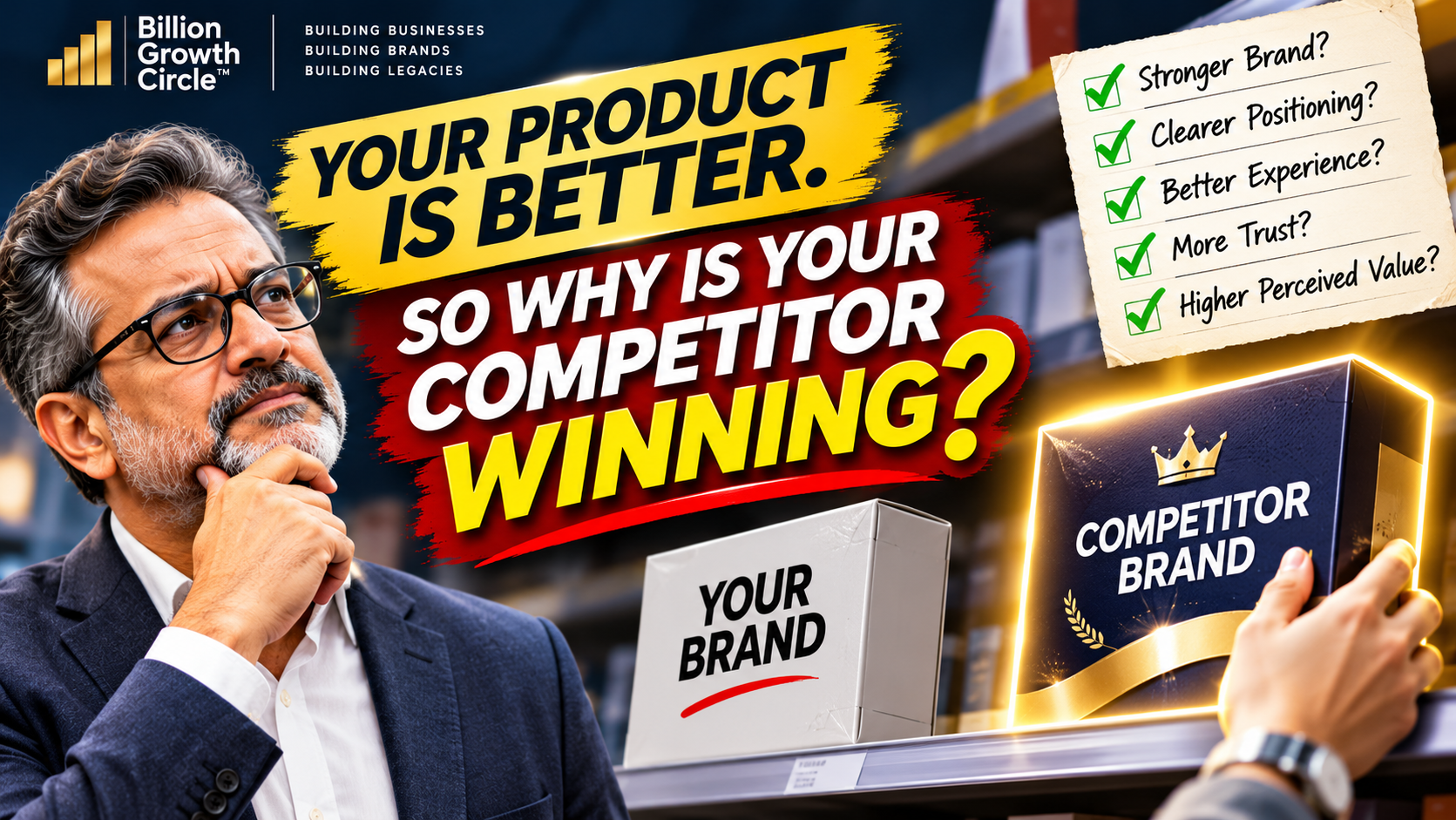
The uncomfortable truth about branding: Being better is not enough. Your customers must also know why you are better, believe it and remember you when it is time to buy.
Imagine this.
You have spent 20 years building your business.
You have invested in better raw materials, superior manufacturing, skilled people, quality control and customer service.
You know your product is better than that of your competitor.
Yet, when customers make a purchase decision, they choose the competitor.
Sometimes, they even pay a higher price for it.
You are left wondering:
- Why are customers not recognising our quality?
- Why are they comparing us only on price?
- Why does the competitor get more enquiries?
- Why do customers remember their name but not ours?
- Why are we struggling to command a premium despite offering a better product?
Here is the uncomfortable truth:
Your competitor may not have a better product. They may simply have a stronger brand.
And in the marketplace, perceived value often influences the buying decision long before a customer experiences actual product quality.
The product quality trap
Many family business owners build their entire growth strategy around one belief:
"If we make a better product, customers will automatically recognise it."
This belief is understandable. In the early years, quality, personal relationships and word-of-mouth may have been enough to build a loyal customer base.
But markets evolve.
Customers have more choices. Competitors communicate more aggressively. Digital platforms influence buying decisions. New brands enter the market with sharper positioning, stronger storytelling and more consistent customer experiences.
Your product may be superior in technical specifications, durability or performance.
But if customers cannot recognise that superiority, it may not influence their purchase decision.
Quality is what you deliver. Brand is what customers believe, remember and expect from you.
Both matter. But they play different roles.
Why customers may be choosing your competitor
Let's examine seven reasons.
1. Your competitor owns a clearer position in the customer's mind
Ask a simple question:
When customers think of your product category, what is the first thing they associate with your brand?
Is it premium quality? Reliability? Innovation? Convenience? Design? Value for money? Specialist expertise?
Or is your answer simply: "We offer good products at competitive prices"?
That is not a strong position. It is a generic claim.
A strong brand stands for something distinctive in the customer's mind.
The competitor may have made a clearer promise, such as:
- The most reliable solution for a specific customer.
- The premium choice for a particular application.
- The easiest experience in the category.
- The specialist in a defined market segment.
The lesson: If you try to mean everything to everyone, customers may struggle to remember what makes you special.
2. Your competitor communicates value. You communicate specifications.
Consider two businesses selling similar products.
Business A says:
"Our product uses high-grade materials, advanced manufacturing and rigorous quality checks."
Business B says:
"Designed to give your family dependable performance for years, with service you can count on."
Business A is describing the product.
Business B is translating product features into customer value.
Customers do care about specifications, but they also want to understand what those specifications mean for their lives or businesses.
A powerful brand translates features into benefits, benefits into outcomes and outcomes into emotional confidence.
Stop merely describing what you make.
Start communicating why it matters.
3. Your competitor looks more credible
Buying decisions involve perceived risk.
Will the product work? Will the company deliver? Will the service team respond? Will the supplier still be around five years from now?
Your competitor may appear more credible because of:
- A professional website.
- Consistent visual identity.
- Clear product information.
- Customer testimonials and verifiable case studies.
- Visible leadership and expertise.
- Strong retail or distribution presentation.
- Consistent communication across channels.
You may have been delivering quality for decades.
But if your brand presentation looks outdated, inconsistent or difficult to understand, customers may form an impression that does not reflect your actual capabilities.
Your brand must look as credible as the business you have built.
4. Your competitor has a better customer experience
Branding does not end with a logo, tagline or advertisement.
It is the total experience a customer has with your business.
Think about the entire journey:
- How easily can a customer discover you?
- How quickly do you respond to an enquiry?
- How clearly do you explain your offering?
- How professional is your sales process?
- How predictable is delivery?
- How effectively do you resolve complaints?
- What happens after the sale?
A competitor with an average product but a smoother customer journey may become the preferred choice.
Customers remember how a business makes them feel, not merely what the product specification sheet says.
5. Your competitor tells a more compelling story
People do not buy only products. They also buy confidence, identity, aspirations and stories.
What is the story behind your business?
Why was it started? What problem does it solve? What makes its approach different? What does it stand for? Why should customers trust it?
Many established family businesses have extraordinary stories, but these stories remain inside the founder's memory.
The next generation may know the history. Employees may know the manufacturing process. Long-standing customers may know the quality.
But the marketplace may know very little.
Your heritage, craftsmanship, innovation, customer commitment and journey can become powerful brand assets when communicated with clarity and authenticity.
Your story is not a substitute for product quality. It gives customers a reason to understand and remember it.
6. Your competitor is more consistent
A customer may see your advertisement on Monday, visit your website on Wednesday, speak to your salesperson on Friday and visit your store the following week.
Does the customer encounter the same promise, quality of presentation and brand personality at every touchpoint?
Or does every interaction feel like it belongs to a different business?
Strong brands build recognition through consistency.
The logo, language, visual identity, customer promise, packaging, sales presentation, website and service experience should reinforce the same positioning.
Consistency creates familiarity. Familiarity, when supported by actual delivery, helps build trust.
7. You are competing on price because you have not built enough perceived differentiation
When customers cannot see a meaningful difference between two competing offerings, price often becomes a convenient basis for comparison.
This is the commoditisation trap.
Your product may have better materials, better engineering, better durability or better service support.
But if these differences are invisible or difficult to understand, customers may treat both products as interchangeable.
A strong brand makes differentiation visible and meaningful.
It gives customers a reason to choose you beyond the lowest quotation.
That is how a business gradually develops pricing power.
The Brand Preference Equation™
At Billion Growth Circle, the way I would approach this challenge is through five interconnected dimensions.
1. Clarity: Does the customer immediately understand what your brand stands for?
2. Differentiation: Is there a compelling reason to choose you over alternatives?
3. Credibility: Does your brand provide evidence that supports its promise?
4. Experience: Does every interaction reinforce the value you claim to deliver?
5. Consistency: Does the market encounter one coherent brand across all touchpoints?
Think of these as five questions, not a mathematical formula. A weakness in any one dimension can dilute the overall strength of your brand.
The 30-minute competitor perception audit
Here is a practical exercise you can do with your leadership team.
Choose your three most important competitors.
Now compare your business against each of them.
| Dimension | Your brand | Competitor A | Competitor B |
|---|---|---|---|
| Positioning clarity | |||
| Distinctive promise | |||
| Website and digital presence | |||
| Visual identity | |||
| Customer reviews and proof | |||
| Sales presentation | |||
| Customer experience | |||
| Perceived value |
Rate each dimension from 1 to 5, based on observable evidence.
Do not award yourself points simply because you believe your product is better.
Look at the business from the customer's perspective.
Then ask five questions:
- What does our competitor communicate more clearly than we do?
- What do customers remember about them?
- What makes customers feel confident buying from them?
- What do we offer that they cannot easily replicate?
- How can we make that difference visible and valuable?
The purpose is not to copy the competitor.
It is to discover where your own brand is failing to communicate its real strengths.
The 90-day Brand Preference Transformation Plan
You do not need to change everything at once. Start with a focused 90-day plan.
Days 1–30: Discover your positioning gap
- Interview a sample of existing customers.
- Ask why they chose you and what they value most.
- Speak to a few customers who chose a competitor, if they are willing.
- Review competitor websites, messaging, packaging and sales presentations.
- Identify your strongest differentiators.
- Define the specific customer segment you want to win.
Deliverable: A clear brand positioning statement and a list of your most defensible points of differentiation.
Days 31–60: Build your brand expression
- Refine your brand promise.
- Develop clear messaging and value propositions.
- Improve your website and product presentation.
- Create a consistent visual identity system.
- Develop customer proof through genuine testimonials and documented case studies.
- Equip your sales team with a compelling brand story and differentiation narrative.
Deliverable: A consistent brand communication and sales toolkit.
Days 61–90: Create market preference
- Align customer touchpoints with your brand promise.
- Train sales and service teams.
- Launch focused content that demonstrates your expertise.
- Test new positioning and messaging with relevant customer segments.
- Track qualified enquiries, conversion, repeat purchases and price realisation.
- Review customer feedback and refine the experience.
Deliverable: A measurable brand-building programme connected to commercial outcomes.
The biggest mistake: Trying to look like a bigger brand without becoming a stronger brand
A new logo does not automatically create a premium brand.
A redesigned website does not automatically create customer preference.
A social media campaign does not automatically create differentiation.
Brand building requires alignment between what you promise, what customers perceive and what you consistently deliver.
The objective is not simply to look bigger.
It is to become more meaningful, more distinctive and more valuable to the customers you want to serve.
A question every family business owner must answer
You have spent years building a better product.
But have you spent enough time building a stronger brand?
If your competitor is winning customers despite having an inferior product, it is time to look beyond manufacturing, pricing and sales.
It is time to examine the customer's perception of your business.
Because in a competitive marketplace, the best product does not automatically become the preferred brand.
The business that creates the strongest combination of value, trust, differentiation and experience has a powerful advantage.
At Billion Growth Circle, we work with family business owners and founders to make this transition—from being known as a good supplier or manufacturer to becoming a differentiated, trusted and premium brand.
Your product may be better.
Now make sure the market knows why.
Ready to discover your brand's blind spots?
Take the first step towards understanding what may be limiting your business's growth, differentiation and market perception.
DISCOVER YOUR BUSINESS BLIND SPOTS.
Billion Growth Circle Building Businesses. Building Brands. Building Legacies.
Frequently Asked Questions
1. Why do customers choose a competitor even when my product is better?
Customers evaluate more than product quality. They also consider brand reputation, trust, convenience, perceived value, availability, service and the overall buying experience. A competitor may communicate these benefits more effectively.
2. How do I build a strong brand for my family business?
Start with a clear target customer, a distinctive positioning, a meaningful brand promise and evidence supporting that promise. Then align your communication, visual identity, sales process and customer experience.
3. Is branding only about a logo and advertising?
No. Branding is the total perception customers form through your promise, product, communication, reputation and experience. A logo and advertising are only parts of the wider brand system.
4. How does branding help a business command premium prices?
A differentiated and trusted brand can reduce perceived buying risk and give customers a meaningful reason to choose an offering beyond price. Premium pricing still needs to be supported by product value and consistent delivery.
5. How can a small or family-owned business compete with bigger brands?
A smaller business can focus on a specific customer segment, a defensible area of expertise, personalised service, distinctive positioning and a consistent customer experience. It does not need to imitate a large competitor.
6. How long does it take to build a strong brand?
There is no universal timeline. Positioning and communication improvements can begin quickly, but building recognition, trust, customer preference and pricing power requires consistent delivery over time.
Then you are the person this room was built for. Let's keep the conversation going.
What did this stir in you?
Leave a comment. Your voice belongs here as much as anyone else's.
Loading comments…